
Try an online search for cabinet types. It won’t take you long to realize there are a myriad of options at different price points and levels of quality.
That’s the problem with cabinet shopping.
With so many confusing terms and options, homeowners end up picking a cabinet line based on price alone, only to find out six months later that the drawers wobble, the finish doesn’t match the sample, or the “custom” cabinets they paid a premium for are really just stock boxes with a few extra paint colors.
Friends, you’re about to spend thousands of dollars on a kitchen. That’s not a decision to make on a guess.
At Railside Furnishings, we’ve spent more than 25 years designing and building cabinets for homes across central Pennsylvania. We’ve seen what happens when homeowners don’t know what they’re actually buying, and we’d rather walk you through the real differences now than let you find out the hard way later.
So let’s break down what stock, semi-custom, and custom cabinets actually mean, what they cost, and how to figure out which one is right for your kitchen.
Table of Contents





TLDR: Custom vs. Semi-Custom vs. Stock Cabinets: What’s the Difference?
- Stock cabinets are pre-built, come in standard sizes, cost $100 to $400 per linear foot, and ship in one to three weeks.
- Semi-custom cabinets offer more finish and size options, cost roughly $150 to $700 per linear foot, and take four to eight weeks to arrive.
- Custom cabinets are built to your exact space and style, cost $500 to $1,200+ per linear foot, and take six to twelve weeks (sometimes longer for detailed work).
- The real differences aren’t just price. They come down to material quality, how well the cabinets fit your actual room, and how many years you’ll get out of them before something needs replacing.
What Are Stock Cabinets?
Stock cabinets are the fast food of the cabinet world. They’re built ahead of time in a handful of standard sizes and finishes, then shipped to a warehouse or store shelf where they sit ready to grab.
Here’s what that means for you:
- Price: Typically $100 to $400 per linear foot, the lowest of the three options.
- Timeline: Usually available in one to three weeks, and sometimes the same day if it’s in stock.
- Materials: Often particleboard or thin plywood with a laminate finish.
- Sizing: Fixed increments, usually 3-inch jumps, so you’ll need filler strips to make them fit your walls.
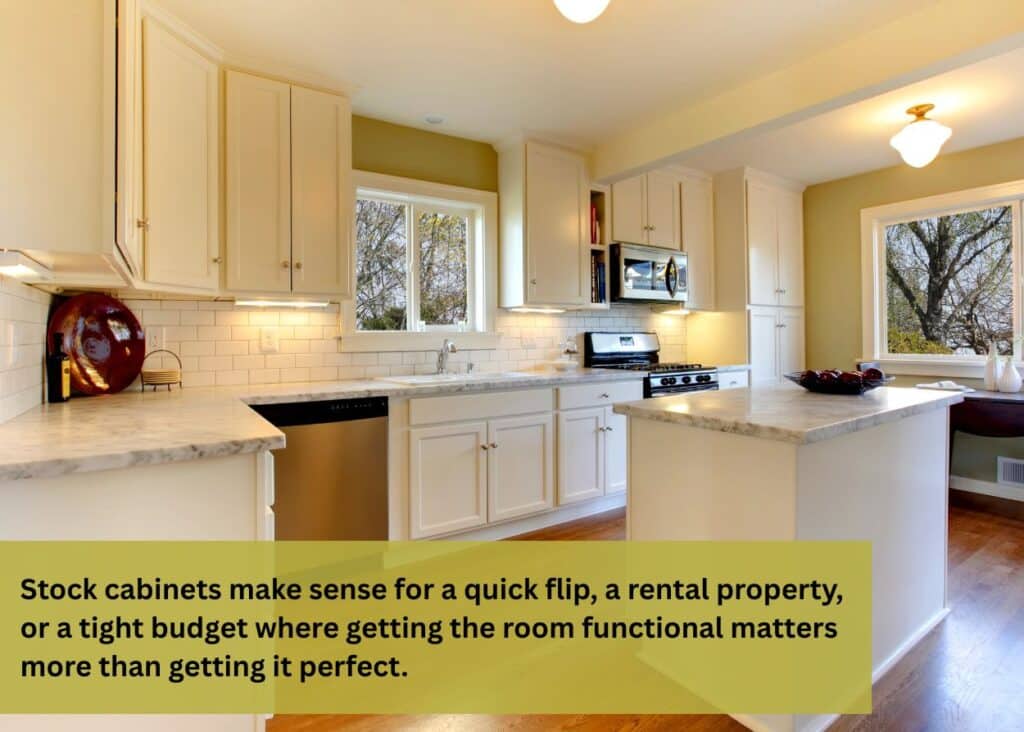
Stock cabinets make sense for a quick flip, a rental property, or a tight budget where getting the room functional matters more than getting it perfect. Just know you’re trading fit and durability for speed and price.
What Are Semi-Custom Cabinets?
Semi-custom cabinets sit in the middle, and that’s exactly why they’re the most popular option on the market today, holding close to 39 percent of the kitchen cabinet market. They start from the same standard box sizes as stock cabinets, but open up a much wider menu of finishes, door styles, and organizational add-ons like pull-out trash bins or spice racks.
But here’s something worth knowing before you sign anything: a lot of cabinets sold as “custom” are actually semi-custom wearing a nicer name tag.
And it makes sense: if you are offering cabinets that come with 30 different paint options and multiple hardware selections that gives the impression of custom. But, it’s not.
If you want truly custom cabinets, it’s worth slowing down and asking a few pointed questions before you assume you’re getting what you’re paying for.
Here’s how to tell the difference:
- Sizing. True custom cabinets are built to your room’s exact measurements, down to the sixteenth of an inch. If the “custom” line you’re looking at still comes in preset sizes, usually 3-inch increments, that’s semi-custom.
- Finish options. A “custom color program” that hands you 20 to 30 paint chips to choose from isn’t the same as a finish built specifically for your project. Real custom finishing can match existing woodwork, adjust tone and sheen, or create something one-of-a-kind.
- The pitch itself. If a salesperson describes “custom” cabinets as picking from a catalog of finishes and hardware, that’s semi-custom language. True custom starts with your space, not a catalog.
So, with that in mind, here are a few things to expect:
- Price: Generally $150 to $700 per linear foot.
- Timeline: Four to eight weeks, since each order is built or finished after you place it.
- Materials: Better plywood construction and hardware than stock lines, though still not top-shelf.
- Sizing: Often adjustable in 1-inch increments instead of 3, which closes some (not all) of the gap problem.
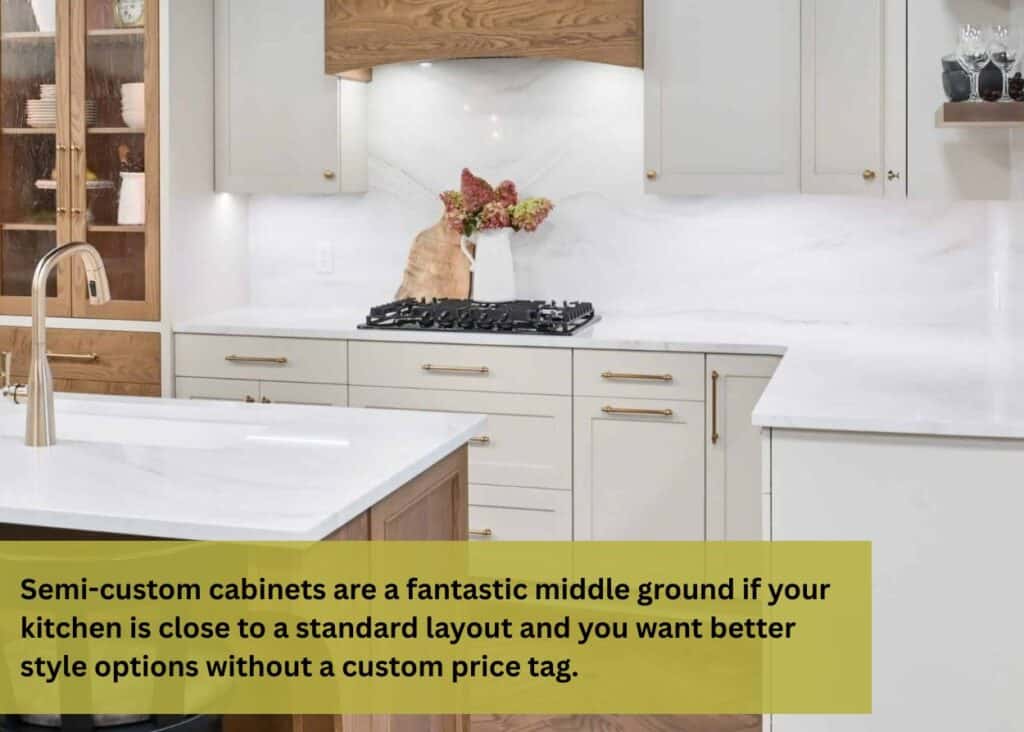
Semi-custom cabinets are a fantastic middle ground if your kitchen is close to a standard layout and you want better style options without a custom price tag. The catch? You’re still working within someone else’s box sizes, so an oddly shaped kitchen will still fight you.
What Are Custom Cabinets?
Custom cabinets are built from scratch for your kitchen and only your kitchen. Every measurement, every door style, every drawer configuration is decided by you and built to match, not picked from a catalog.
Here’s what sets them apart:
- Price: Typically $500 to $1,200+ per linear foot.
- Timeline: Six to twelve weeks, sometimes longer for detailed or large-scale projects.
- Materials: Solid wood, plywood boxes, dovetail joinery, and soft-close hardware as the standard, not the upgrade.
- Sizing: Built to your exact dimensions, down to the odd corner, low ceiling, or that one wall that isn’t quite square.
This is where a shop like ours does its best work. When we build custom cabinets for a family in Mifflinburg or the surrounding counties, we’re solving problems stock and semi-custom simply can’t: wasted corners, awkward islands, a pantry that needs to do three jobs at once. And because it’s real wood built by Amish craftsmen, it’s made to be handed down, not replaced.
Three Differences That Actually Matter
Price gets all the attention, but it’s not the only number worth watching. Here are the three differences that tend to make or break a homeowner’s satisfaction five years down the road.
- Material quality. Stock cabinets often use particleboard boxes that swell and sag under sink leaks or steam. Custom cabinets built with solid wood and real plywood shrug that off for decades.
- Fit. A filler strip can hide a gap, but it can’t fix wasted storage. Custom cabinets use every inch of your kitchen, which matters even more in older homes where walls are rarely perfectly square.
- Lifespan. Stock cabinets are built to last long enough to sell a house. Custom cabinets, built with dovetail joints and solid wood frames, can hold up for 20 to 30 years of daily use, roughly double what stock cabinetry typically offers.
None of that means stock or semi-custom is a bad choice. It means the choice should match how long you plan to live with the results.
How to Choose the Right Cabinets for Your Situation
So which one is actually right for you? Here’s a quick gut check.
Choose stock cabinets if:
- You’re working with a tight budget and a standard-sized kitchen.
- You need the project done in a few weeks, not a few months.
- This is a rental, flip, or a home you don’t plan to stay in long term.
Choose semi-custom cabinets if:
- Your kitchen is a fairly standard shape, but you want more control over finish and style.
- You have a moderate budget and can wait four to eight weeks.
- You want better hardware and organization than stock offers, without the full custom price tag.
Choose custom cabinets if:
- Your kitchen has odd angles, low ceilings, or wasted corners a standard box can’t solve.
- You have specific functionality you want your cabinets to have.
- You want real wood construction built to last two or three decades.
- You’re planning to stay in your home long enough to enjoy what you paid for, or you’re building the kind of piece you want to pass down.
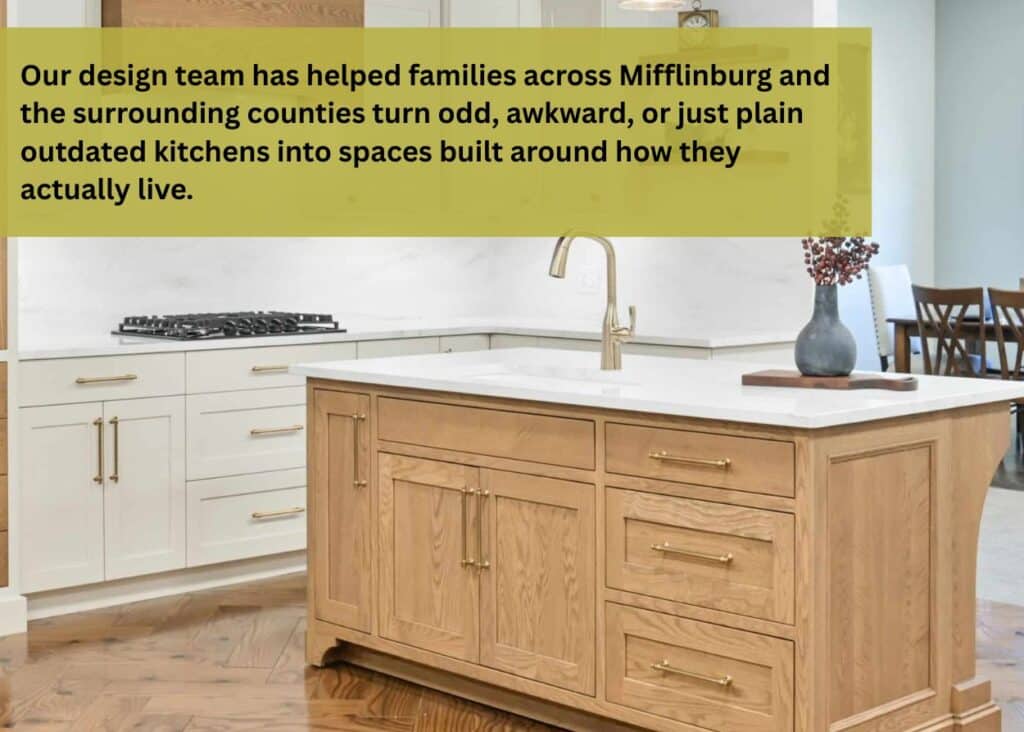
If that last one sounds like you, we’d love to talk. Our design team has helped families across Mifflinburg and the surrounding counties turn odd, awkward, or just plain outdated kitchens into spaces built around how they actually live. We’ll walk your space, sketch a plan, and show you a full-color 3D rendering before a single board gets cut, so you know exactly what you’re getting before you commit.
Reach out to Railside Furnishings and let’s start the conversation.